Apr 23, 2026
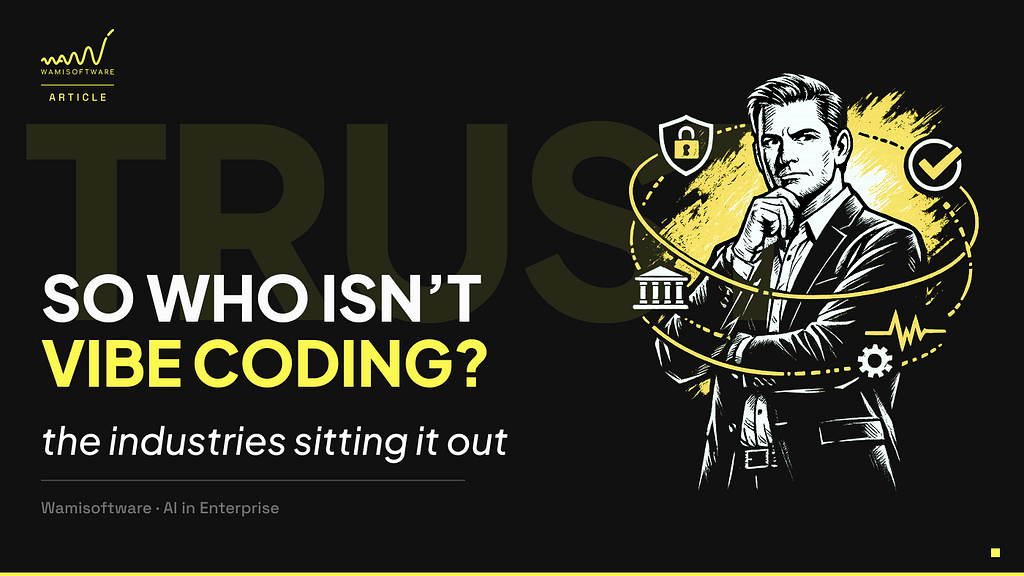
So Who Isn’t Vibe Coding Right Now?
The industries where “move fast and break things” was never an option and what that means for AI adoption in 2026. Scroll through LinkedIn for ten minutes and you’ll get the impression that everyone, everywhere, is building products with Vibe Coding. Startups launching in a week. Non-technical founders shipping features before they’ve hired their first developer. AI generating thousands of lines of code in the tim…
The industries where “move fast and break things” was never an option and what that means for AI adoption in 2026.
Scroll through LinkedIn for ten minutes and you’ll get the impression that everyone, everywhere, is building products with Vibe Coding.
Startups launching in a week. Non-technical founders shipping features before they’ve hired their first developer. AI generating thousands of lines of code in the time it takes to finish a coffee.
The narrative is compelling. And for a lot of contexts, it’s accurate.
But there are entire industries quietly sitting this conversation out. Not because they don’t understand the technology. But because the stakes of getting it wrong are fundamentally different.
Banking: Where Every Line of Code Goes to Committee
In banking, code doesn’t just work or not work. It goes through legal review, security testing, and committee approval before it touches anything that matters.
PCI DSS, Basel III, local financial regulators — these aren’t bureaucratic obstacles to work around. They’re the architecture of trust that the entire system runs on. A payment platform that fails compliance isn’t a startup with a bug to fix. It’s a regulated entity with a license at risk.
Vibe Coding can exist in this environment. But only as a tool in the hands of an experienced team that understands every implication of what’s being generated and can defend every architectural decision to an auditor.
The speed advantage of AI doesn’t disappear in banking. It gets channeled differently.
Healthcare: Where a Bug Is a Patient Risk
Healthcare has its own version of this reality, and it’s more personal.
HIPAA, GDPR for medical data, medical software certification requirements — these frameworks exist because the cost of failure here isn’t measured in downtime or lost revenue. It’s measured in patient outcomes.
A bug in a fintech app might mean a failed transaction. A bug in clinical software might mean a wrong dosage, a missed diagnosis, a delayed treatment.
No regulator anywhere will accept “we generated this with AI” as sufficient justification for an architectural decision in a medical system. And they shouldn’t. The bar for explainability, auditability, and human oversight is high and it’s high for good reason.
This doesn’t make AI irrelevant in healthcare. It makes the governance layer around AI more important than the AI itself.
Energy: Where Reliability Always Beats Speed
Energy infrastructure operates on a different set of assumptions than almost any other industry.
Critical systems. Millions of people depending on them. Failure scenarios that get modeled before a single line of integration code gets written.
Every integration in this sector means months of testing. Every update requires sign-off from grid operators who are responsible for keeping the lights on. Every architectural decision is made with an awareness of what happens when things go wrong — not just what happens when they go right.
Speed yields to reliability here. Not as a cultural preference, but as an operational necessity. A power grid that fails affects hospitals, water treatment facilities, emergency services. The consequences of a rushed deployment don’t stay contained.
So Does Vibe Coding Have No Place in Enterprise?
That’s the wrong conclusion to draw.
Vibe Coding absolutely works in enterprise environments. It just works differently than it does in a startup building an MVP on a two-week timeline.
In regulated industries, it becomes a tool for specific, bounded tasks: accelerating development within a secure perimeter, automating routine work that doesn’t touch critical systems, generating code under Senior architect oversight where every output gets reviewed before it moves forward.
The key word is oversight. Not because the technology isn’t capable, but because accountability in these industries is non-negotiable. Someone has to be able to explain every decision — to a regulator, to an auditor, to a patient, to a grid operator.
That someone is a human with expertise and context. The AI is a powerful tool in their hands. It doesn’t replace the judgment.
Two Different Paces of Change — Both Valid
Vibe Coding is genuinely changing the software industry. The productivity gains are real, the accessibility is real, the pace of what’s possible has shifted.
But the pace of change is different across sectors. And that’s not a problem to solve — it’s a feature of how risk is distributed.
A startup that moves fast and breaks something can iterate. A hospital that moves fast and breaks something has a different kind of conversation to have. An energy company that moves fast and breaks something might make the news.
The companies that will win in enterprise AI adoption aren’t the ones that force-fit startup methodologies into regulated environments. They’re the ones that understand the difference and build accordingly.
Wamisoftware works with startups and enterprise clients on AI integration and software development. If you’re thinking about how AI fits into a regulated environment, we’re happy to start with the hard questions.
picture by <a href=”https://storyset.com/work">Work illustrations by Storyset</a>