Jun 18, 2026
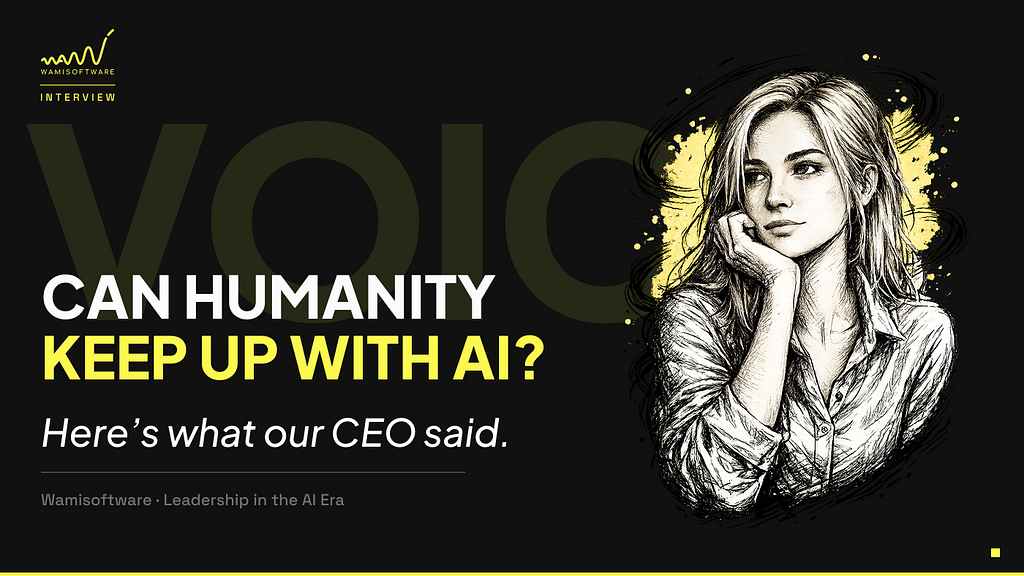
Can Humanity Keep Up With AI? We Asked Kateryna, CEO of Wamisoftware. Here’s What She Said.
In January 2026, Dario Amodei — CEO of Anthropic, the company behind Claude — published 20,000 words about what he called “The Adolescence of Technology.” His central warning: AI is about to test humanity as a species. That we’re approaching a moment where humans will be handed almost unimaginable power and it’s deeply unclear whether our social, political, and technological systems are mature enough to wield it r…
In January 2026, Dario Amodei — CEO of Anthropic, the company behind Claude — published 20,000 words about what he called “The Adolescence of Technology.” His central warning: AI is about to test humanity as a species. That we’re approaching a moment where humans will be handed almost unimaginable power and it’s deeply unclear whether our social, political, and technological systems are mature enough to wield it responsibly.
Amodei warned of the “real danger” that superhuman intelligence could cause civilization-level damage, and wrote that if exponential AI progress continues which has a decade-long track record supporting it — then within just a few years AI will be better than humans at essentially everything.
We shared the essay internally. And then we asked our CEO what she actually thought.
Her response was more honest than a company blog post usually gets.
“I’m Tired”
“I love technology. Genuinely, wholeheartedly. I find what’s happening fascinating, I follow the trends, I’m genuinely excited by what’s become possible in the last two years.
And at the same time — I’m tired.
Tired of the pace. Of the feeling that every week something new arrives and if you didn’t catch it you’re already behind. Of a race that doesn’t stop even for a moment.”
This is not the kind of thing a tech company CEO is supposed to say publicly. And yet it’s exactly what many people working in the industry actually feel — they just rarely say it out loud.
The pace of change in software development in 2026 is genuinely unprecedented. 84% of developers now use AI coding tools, and 51% reach for them every single day but widespread adoption has not produced widespread confidence. The tools are everywhere. The clarity about what they mean is not.
The Paradox at the Center
What made Kateryna’s reaction particularly interesting was what she noticed about Amodei’s essay itself.
“The strangest part is that the person building one of the most powerful AI systems in the world feels it too. He’s calling for a pause. And at the same time continuing the race because if you stop, others won’t.”
This is the central paradox of where the AI industry sits in 2026. The people who understand the technology most deeply are also the ones most worried about it. And their worry doesn’t slow them down — it can’t, because the competitive dynamics don’t allow for unilateral pauses.
Anthropic has long positioned itself as a safety-focused AI lab — earlier this year it refused to let the US military use its models for domestic surveillance and fully autonomous weapons. But it has continued to release increasingly powerful models, and in February walked back a key safety pledge, saying it would no longer hold back potentially dangerous AI if rivals were close to matching its capabilities.
This isn’t hypocrisy. It’s the logical outcome of a race nobody can afford to exit.
What This Means for Companies Building With AI
For a company like ours — building software products, working with AI tools daily, integrating AI into client systems — this isn’t abstract philosophy. It’s the context in which every decision gets made.
Do we adopt the latest agent framework before we fully understand its implications? Do we build faster because clients expect it, even when faster means less time to think through what we’re building? Do we reassure clients that AI is under control when the honest answer is that nobody is fully sure?
Kateryna’s response to these questions was characteristically direct:
“I don’t know how to sit with this correctly. I think nobody does. But somehow it will work out. That’s how it’s been with every technological revolution. People adapted — even when it always felt like this time was too fast.”
It leaves you hoping we’ll figure it out this time too.
What We Actually Do About It
Hope is not a strategy. So alongside the honest uncertainty, there are practical commitments that shape how we work.
We keep humans in the loop on architectural decisions — not because we distrust AI tools, but because accountability requires a person who can explain and own what was built. When AI agents generate code, a Senior developer reviews and takes responsibility for what gets deployed.
We’re honest with clients about what AI can and can’t do. The temptation to oversell AI capabilities is real — clients often want to hear that AI will solve their problems faster and cheaper than it actually will. We resist this, because the relationship breaks down when the reality doesn’t match the pitch.
We think about the long-term implications of what we build. An AI system deployed in energy infrastructure, or healthcare, or financial services has consequences that extend far beyond the project timeline. Building with that awareness changes the decisions you make.
None of this resolves the larger questions Amodei was writing about. But it’s the honest answer to what a company that builds with AI can actually do in 2026.
The feeling Kateryna described — loving the technology and being exhausted by its pace simultaneously is not a contradiction. It’s an accurate description of what it’s like to work in this industry right now.
The people who only feel the excitement are missing something. The people who only feel the exhaustion are also missing something.
Holding both at once, and continuing to do careful work anyway, might be the most honest response available.
We’re trying to do that. We don’t always succeed. But we think it’s worth trying.
Wamisoftware has been building software products since 2014. We work with startups and enterprise clients on AI integration, agentic development workflows, and technical architecture. Kateryna, our CEO, writes about technology, leadership, and the honest experience of building a company in a rapidly changing world.