Jul 16, 2026
What “Cost-Effective Development” Actually Means (And Why Most Companies Get It Wrong)
Everyone wants it. Few can define it. Here’s what the math actually looks like. There’s a conversation we have often with clients before a project starts. They say they want cost-effective development. We ask what they mean by that. Most of the time, the answer is some version of “cheaper than what we’ve seen so far.” That’s understandable. But it’s also the beginning of a very common and expensive mistake. Cost-e…
Everyone wants it. Few can define it. Here’s what the math actually looks like.
There’s a conversation we have often with clients before a project starts.
They say they want cost-effective development. We ask what they mean by that. Most of the time, the answer is some version of “cheaper than what we’ve seen so far.”
That’s understandable. But it’s also the beginning of a very common and expensive mistake.
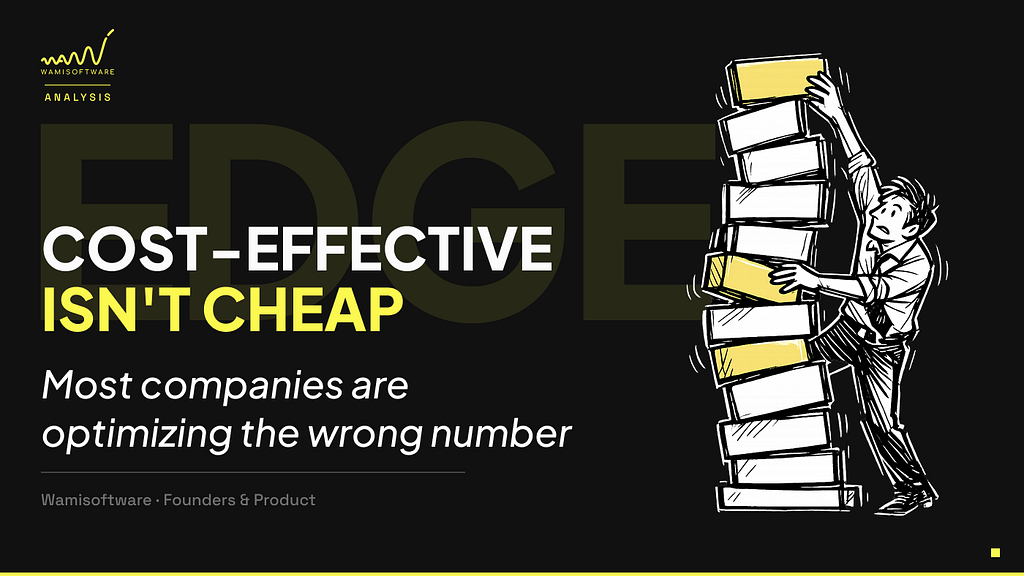
Cost-effective means something different from cheap. And the difference between them usually becomes visible about twelve months after a project ends when the bills for maintaining, fixing, and rebuilding what was built start arriving.
The Number Most Companies Aren’t Calculating
When businesses evaluate development costs, they typically look at one number: the project invoice.
That number matters. But it’s not the right number to optimize for.
The real cost of a software product is the sum of several things that most procurement processes don’t account for:
The initial development cost. The ongoing maintenance cost. The cost of fixing bugs that reach production. The cost of refactoring when the product needs to scale and the original architecture won’t support it. The cost of downtime when systems fail. And the cost of the engineering time spent explaining to a new team what the previous team built and why.
A development team that charges less but builds on weak architectural foundations doesn’t save you money. It defers costs and typically with interest. The invoice is lower. The total expenditure over three years is almost always higher.
The right metric is total cost over the product’s lifetime, not the invoice at the start.
The Four Things That Actually Determine Cost-Effectiveness
After twelve years of building software products, we’ve found that cost-effective development consistently shares four characteristics. Not all vendors provide all four. The absence of any one of them tends to show up eventually in the total cost.
1. The Right Architecture From Day One
Architecture is a multiplier. A good architectural decision made early makes every subsequent feature cheaper to build. A poor architectural decision made early makes every subsequent feature more expensive — sometimes significantly so.
This isn’t a metaphor. It’s arithmetic. When an engineering team has to work around a structural limitation in the codebase, every task takes longer. When that limitation affects a core system, the overhead compounds across every part of the product that touches it.
Poor architecture is effectively a tax on every change you make to the product for as long as the product exists. The tax rate varies by how bad the original decisions were. But the tax never disappears until you pay the refactoring bill — which is typically far larger than the cost savings that created the problem in the first place.
Cost-effective development makes decisions that allow fast movement today and remain sound two years from now.
2. Speed Without Technical Debt
AI-assisted development has genuinely changed what’s possible in terms of development speed. One experienced engineer working with AI agents can now produce output that previously required a larger team, and do it faster.
This is real, and we use it in our own projects.
But speed without quality control is the accelerated accumulation of technical debt — code that works today but creates problems tomorrow, shortcuts that seem reasonable individually and become structural issues collectively.
The discipline that makes AI-assisted development cost-effective is maintaining human oversight of architectural decisions and code quality while using AI to accelerate execution. The agent handles the routine. The senior engineer reviews the output, owns the architecture, and takes responsibility for what gets deployed.
Without that oversight layer, AI development produces code faster. It also produces problems faster.
3. Transparent Pricing Before the Work Starts
Fixed-price contracts can be cost-effective. They can also produce the opposite result — if the scope wasn’t well-defined when the price was set, the outcome is typically either a product that doesn’t match what was needed, or a renegotiation that adds cost at the worst possible moment.
What actually makes pricing cost-effective is transparency: the client understands what the cost consists of, what drives it up or down, and what decisions they can make to influence it.
This means being honest about uncertainty before the project starts. A well-defined MVP with clear scope can be estimated reliably. A complex system with evolving requirements cannot and pretending otherwise creates the conditions for a surprise invoice at the end.
Surprise invoices are a sign of non-transparent development. The cost was always there. It just wasn’t visible until it was unavoidable.
4. A Team That Thinks About the Business, Not Just the Code
The most expensive mistake in software development is building the wrong thing.
A team that executes requirements without questioning them will build exactly what they’re asked to build. If what they’re asked to build doesn’t solve the actual business problem, they’ll deliver that faithfully too.
Cost-effective development requires engineers and project managers who ask why before they ask how. Who push back when a requested feature doesn’t map to the problem being described. Who bring the client into the tradeoff conversation rather than optimizing for the easiest interpretation of the spec.
This requires a relationship where the vendor feels accountable for business outcomes, not just technical delivery. That relationship takes time to establish. But a team that builds what it’s told without asking questions tends to produce exactly the kind of expensive course corrections that make development feel anything but cost-effective in retrospect.
What This Looks Like in Practice
The organizations that consistently achieve the best ratio of value to total expenditure over time tend to share a few practices.
They invest in the discovery phase before committing to development. Understanding what to build, for whom, and how it creates value is the single highest-ROI activity in a product lifecycle. The cost of changing direction at the requirements stage is a fraction of the cost of changing direction after six months of development.
They treat architecture as a strategic asset. The decisions made about how a system is structured determine its cost trajectory for years. Organizations that treat architecture as something engineers handle without business involvement often end up surprised by what those decisions cost them later.
They measure vendor quality by total cost of ownership, not project cost. The team that delivers on time and on budget but leaves behind a codebase that requires constant maintenance isn’t cost-effective. The team that charges more but delivers something that runs cleanly for three years almost always is.
And they maintain enough internal technical literacy to evaluate what they’re receiving. Organizations that can’t read the quality of what they’re getting are in a weak position to ensure they’re getting cost-effective work — regardless of what the contract says.
The Twelve-Month Test
There’s a simple way to evaluate whether your last development project was actually cost-effective: look at what you’re spending twelve months later.
What’s the monthly cost of maintaining what was built? How often does it need fixes? How much did it cost to add the last major feature? How long did it take? How confident is the team in the stability of the system?
The answers to those questions are the real measure of whether the original investment was cost-effective — not the number on the original invoice.
The difference between cheap development and cost-effective development is always visible eventually. The only question is how long it takes to become visible, and how much it costs by the time it does.
Wamisoftware has been building software products since 2014. We work with startups and enterprise clients who care about what gets built today and what it costs to run in two years.


