Jun 11, 2026
The New Founders Don’t Think Like Developers. That’s Their Edge.
Something shifted in who builds the best products. It’s worth paying attention to. The founders who excite us most right now are not technical. They don’t think in functions and frameworks. They don’t optimize for clean code or elegant architecture. They think about people — what frustrates them, what they actually want, what would make them come back. And in 2026, that turns out to be exactly the right brain for …
Something shifted in who builds the best products. It’s worth paying attention to.
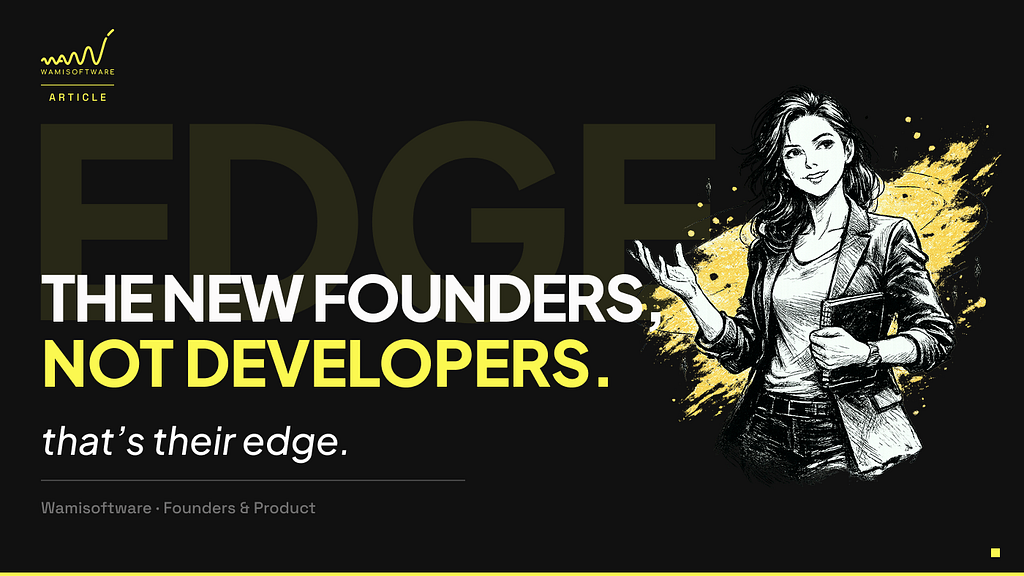
The founders who excite us most right now are not technical.
They don’t think in functions and frameworks. They don’t optimize for clean code or elegant architecture. They think about people — what frustrates them, what they actually want, what would make them come back.
And in 2026, that turns out to be exactly the right brain for building software.
They start with obsession, not specification
A technical founder often starts with a system. A data model, a stack decision, a mental map of how the pieces fit together.
A non-technical founder starts with a fixation on a problem. Why does this exist. Who suffers from it. What would feel obviously right to the person experiencing it.
This sounds less rigorous. In practice it produces products that people actually use because the product was designed from the user’s perspective from the very first thought, not retrofitted onto it after the architecture was decided.
They make product decisions faster because they’re not afraid of the technical cost
A developer who understands how something gets built will sometimes slow down a product decision because they can already see how hard it will be to implement. That instinct is valuable. It’s also, sometimes, the reason good ideas don’t get tried.
Non-technical founders don’t have that filter. They decide what the product should do based on whether it’s right and then figure out how to build it.
This creates a different kind of momentum. Not reckless. Directed. The product moves toward what it should be without the internal negotiation between “what’s right” and “what’s easy to build.”
They’re comfortable not knowing and that’s a superpower
Most technical people find ambiguity uncomfortable. They want to understand the full system before they commit to a direction. This produces careful, well-considered architecture and very slow early-stage products.
Non-technical founders are often genuinely comfortable saying “I don’t know how this works yet, let’s find out.” They treat uncertainty as the natural state of early-stage building, not a problem to be solved before starting.
In a world where AI can execute faster than anyone can plan, the ability to move into uncertainty without freezing is worth more than knowing the right answer in advance.
They’re not attached to the code — only to whether it works
When a developer writes code, there’s an investment. Time, craft, the particular way they solved a hard problem. Deleting it has a cost that’s hard to separate from the technical cost.
Non-technical founders have none of that attachment. If something isn’t working, it goes. The product is the thing they care about. The code is just how it exists right now.
In AI-assisted development, this turns out to matter a lot. Agents generate fast. The question is whether you’re willing to throw away what they generated and try something different. Non-technical founders usually are.
The model that works best pairs this product clarity with a Senior developer who owns the technical foundation — architecture, security, the decisions that determine whether what’s being built will hold up. The founder brings the thinking. The Senior ensures it’s built to last. The AI executes.
That combination, in 2026, ships real products.
Wamisoftware works with non-technical and technical founders on AI-assisted development. We’ve watched this new generation of builders firsthand and we’re genuinely impressed.