Jun 25, 2026
The Junior Talent Pipeline Is Breaking. Aviation Already Showed Us What That Costs.
A look at the data behind 2026’s layoffs and an organizational lesson from a different industry. Tech layoffs in 2026 are averaging 1,115 job cuts per day nearly double last year’s pace. Meta, Oracle, and Block all cite AI as the reason. But the cuts aren’t evenly distributed. Employment for developers aged 22–25 has fallen nearly 20% from its 2022 peak, while employment for developers over 26 has grown. The share…
A look at the data behind 2026’s layoffs and an organizational lesson from a different industry.
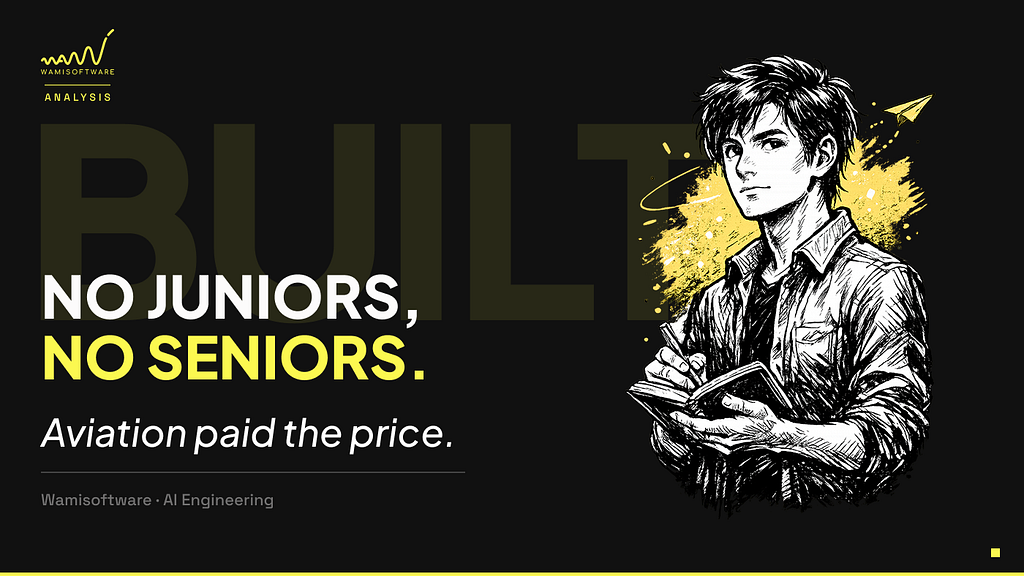
Tech layoffs in 2026 are averaging 1,115 job cuts per day nearly double last year’s pace. Meta, Oracle, and Block all cite AI as the reason.
But the cuts aren’t evenly distributed. Employment for developers aged 22–25 has fallen nearly 20% from its 2022 peak, while employment for developers over 26 has grown. The share of companies actively cutting junior roles jumped from 17% to 43% in a single year.
This is a structural shift away from junior talent. And there’s a precedent in another industry worth looking at.
An Organizational Lesson From Aviation
In 2019, Bloomberg reported on Boeing’s cost-cutting practices during a difficult period for the company. The reporting documented how Boeing and its subcontractors had relied on temporary contract workers, often without deep aerospace backgrounds, to handle software work — part of a broader push to cut engineering costs while laying off experienced engineers.
The full causes behind Boeing’s subsequent engineering challenges were complex and remain debated. What’s better documented is what happened to the company’s internal capability afterward: Boeing spent years trying to rebuild the depth of in-house expertise it had before that period of cost-cutting. Stepping back from experienced engineers didn’t just save money short-term — it removed a generation’s worth of mentorship from the pipeline, and rebuilding that depth proved far slower than dismantling it had been.
The lesson isn’t about any single technical failure. It’s about what happens organizationally when a company stops investing in the people who would have become its senior experts.
Why This Matters Now
MIT researcher Andrew McAfee makes a related argument about today’s AI-driven layoffs: “How else are people going to learn to do the job except via on-the-job learning and training apprenticeship? When we put too much automation in that too quickly, we lose that apprenticeship ladder.”
AI tools now let senior engineers handle the boilerplate coding and routine testing that junior roles were historically built around compressing the entry-level career on-ramp without eliminating senior engineering as a discipline. Efficient in the short term. The risk is what it does to available talent five to ten years out, exactly when companies expect AI-augmented seniors to be their most valuable asset.
As Liz Eversoll, CEO of Career Highways, puts it: “The real risk isn’t that AI eliminates human contribution — it’s that companies unintentionally erode their future talent pipeline by removing the very roles where emerging employees typically learn, stretch, and build foundational skills.”
Not Every Company Is Making the Same Bet
IBM has reportedly tripled entry-level hiring in 2026, with one executive telling Nikkei Asia the company plans to bring junior talent in and train them rather than exclude them: “You have to bring them in. You have to have them learn on the job.” Salesforce has expanded graduate recruitment tied to its AI work.
These companies are treating junior hires as a long-term investment rather than a cost to cut — the opposite calculation from most current layoffs. The split suggests this isn’t simply “AI makes junior roles obsolete.” It’s a choice about optimizing for this quarter or for the senior talent needed in 2035.
What This Means in Practice
We work with AI tools daily and believe in their value for accelerating development. That doesn’t change our view that judgment remains the part of the system AI cannot generate on its own.
Architectural decisions, the ability to read a half-finished requirement and know what’s actually being asked for, the judgment to push back on a plan that won’t hold up in production — these come from years of exposure to exactly the kind of work currently being automated away from junior engineers.
If that exposure disappears for a generation of developers, the senior engineers of 2035 don’t simply not exist — the pipeline that would have produced them gets interrupted at the source. The apprenticeship ladder took decades to build in software engineering, just as it did in aerospace. History suggests it doesn’t rebuild on the timeline anyone hopes for.
Wamisoftware has been building software products since 2014. We work with senior engineers, AI tools, and clients who care about what gets built today and what holds up in five years.