May 28, 2026
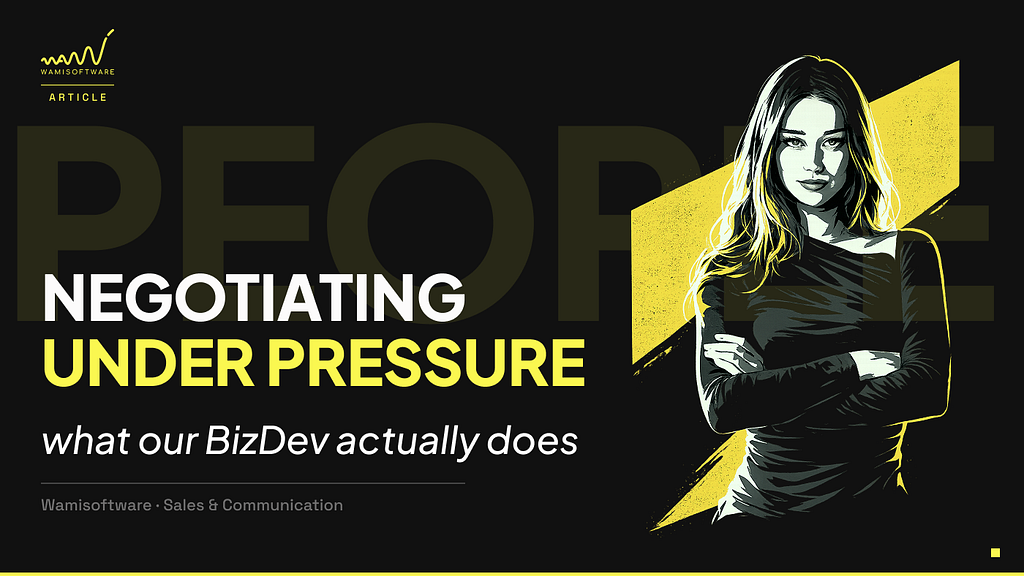
Negotiating Under Pressure at Enterprise Conferences: What Our BizDev Actually Does
We asked our Business Development Manager how she handles high-stakes conversations at enterprise events. Here’s what she shared. Conference season is in full swing. And if you work in B2B sales or business development, you know the particular kind of pressure that comes with enterprise events. It’s not the same as a startup conference. At startup events, conversations tend to be horizontal. People are curious, op…
We asked our Business Development Manager how she handles high-stakes conversations at enterprise events. Here’s what she shared.
Conference season is in full swing. And if you work in B2B sales or business development, you know the particular kind of pressure that comes with enterprise events.
It’s not the same as a startup conference.
At startup events, conversations tend to be horizontal. People are curious, open, willing to engage as equals. Enterprise events operate on different dynamics. Hierarchies are visible. Authority is performed. The conversations require a different kind of preparation — not just on content, but on how you show up in the room.
We asked our BizDev Manager what actually works. Here’s her approach.
Name the Dynamic Before the Conversation Starts
Before a difficult conversation, it helps to be clear about what kind of room you’re walking into.
Enterprise environments have their own social rules. Seniority is performed. Decisions are rarely made on the spot. The person across from you may arrive with assumptions about who you are before you’ve said a word.
Recognizing this in advance — rather than being surprised by it mid-conversation — changes how you respond to it.
The Pause as a Tool
When pressure builds, the instinct is to respond quickly. To fill silence, defend a position, match the energy in the room.
Doing the opposite tends to work better.
A 2–3 second pause before answering does two things: it creates space to think clearly, and it signals that what comes next is considered rather than reactive. People who speak deliberately are perceived as more confident. That holds even when the conversation is uncomfortable.
Questions Instead of Defense
When a conversation starts to feel adversarial, shifting into question mode changes the dynamic.
“What’s the most important criterion for you when choosing a partner?” or “How are you currently handling this challenge?”
Questions move the conversation away from a contest of positions and toward something more useful: understanding. They also signal genuine interest in the other person’s situation which, in enterprise contexts where people are accustomed to being pitched at, tends to stand out.
Context
It helps to be clear, internally, about what the goal of the conversation actually is.
The goal isn’t to win the room or prove a point. It’s to understand whether there’s a real fit and if there is, to build the beginning of something that could become a partnership.
That reframe reduces the pressure. And it tends to make the conversation go better, because people can sense when someone is genuinely interested in them rather than performing.
Don’t Fight for the Last Word
In high-pressure conversations, resistance tends to create resistance.
Partial agreement — finding something real in what the other person has said and acknowledging it before adding your own perspective — opens space that direct contradiction closes.
“Yes, and at the same time…” instead of “But…”
It’s a small shift in language. The effect on the conversation is larger.
What This Actually Takes
Self-control in negotiation isn’t about suppressing what you feel. It’s about feeling the pressure clearly and still being able to act with intention.
That takes practice. It comes from walking into enough difficult rooms and learning, over time, what actually works — not what sounds good in theory.
Enterprise environments have their own particular dynamics. Learning to navigate them well is a skill, and like any skill, it develops through repetition and honest reflection.
We think it’s worth sharing what we’ve learned along the way.
At Wamisoftware, the human side of business development — the conversations, the relationships, the navigating of complex dynamics — is as much a part of our work as the technical side.
Have you faced similar dynamics at enterprise events? We’d genuinely like to hear how you approach them.