May 21, 2026
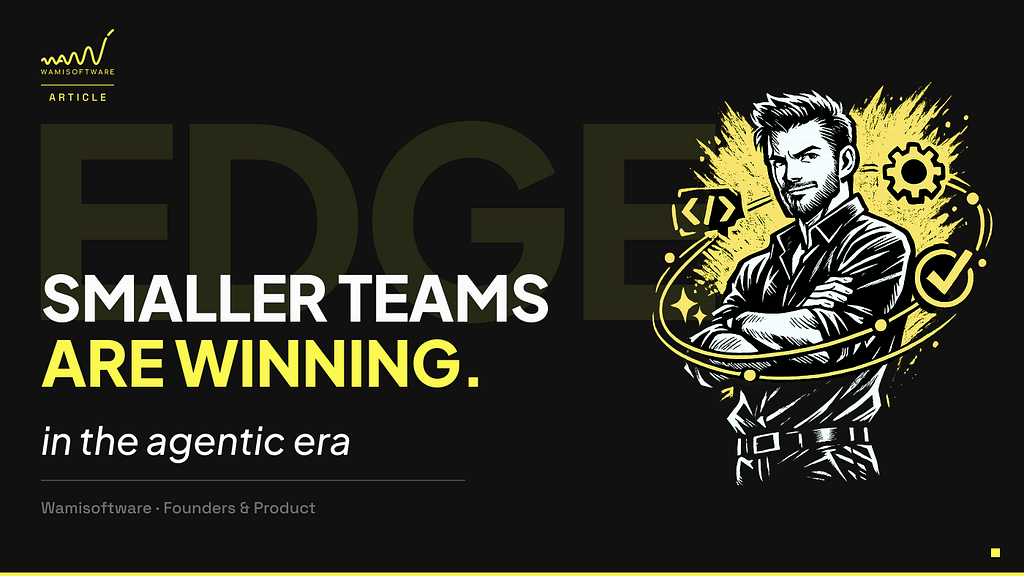
Why Smaller Teams Are Winning in the Agentic Era
The assumption that bigger engineering teams build better products is being quietly disproved. Here’s what’s actually happening. For most of the software industry’s history, scale meant headcount. More engineers meant more features, faster shipping, better products. The companies that could afford large engineering organizations had a structural advantage over those that couldn’t. That assumption is breaking down.…
The assumption that bigger engineering teams build better products is being quietly disproved. Here’s what’s actually happening.
For most of the software industry’s history, scale meant headcount.
More engineers meant more features, faster shipping, better products. The companies that could afford large engineering organizations had a structural advantage over those that couldn’t.
That assumption is breaking down. And the companies paying attention to why are quietly repositioning themselves for a significant shift.
The Data Is Already There
Gartner predicts that 80% of organizations will evolve large software engineering teams into smaller, AI-augmented teams by 2030.
That’s not a distant forecast. It’s a description of something already in motion.
U.S. software developer employment reached approximately 2.2 million in 2025 — an 8.5% increase year over year, the highest on record. Early data for Q1 2026 shows developer employment about 4% higher than a year prior.
So developers aren’t disappearing. The ratio of output per developer is changing. And that ratio change is what makes smaller teams viable in ways they weren’t before.
What’s Actually Different Now
The shift from AI copilots to AI agents is the mechanism behind this change and it’s worth being precise about what that means.
A copilot suggests. An agent executes.
A copilot writes a function when asked. An agent refactors an entire module, writes tests, runs them, fixes failures, and opens a pull request. The human reviews outcomes, not inputs.
When the human reviews outcomes rather than inputs, the economics of a team change fundamentally. One person with strong judgment and a well-configured agent stack can now cover ground that previously required multiple people — not because the human became more capable, but because the execution layer got faster and more autonomous.
Tasks that once required weeks of cross-team coordination can become focused working sessions. Organizations can start staffing projects dynamically, bringing in specialists for specific challenges and shifting resources without the traditional friction.
The Advantage It’s Decision Quality
Here’s where the conventional narrative about smaller teams gets it wrong.
Most people frame the agentic advantage as: fewer people, same output, lower cost. That’s true but incomplete. The deeper advantage is that smaller teams make better decisions.
In a large engineering organization, a significant amount of human energy goes into coordination — aligning on priorities, managing dependencies, syncing across workstreams. This coordination overhead grows roughly quadratically with team size. A team of 20 doesn’t do twice the work of a team of 10. It does the work of a team of 10 while also managing the complexity of being 20 people.
A small team with strong AI tooling doesn’t have that overhead. The cognitive energy that would go into coordination goes into the actual problem. Priorities are clearer. Context is shared naturally. When something needs to change, it changes without a three-sprint planning process.
This is why the companies winning with agentic workflows aren’t necessarily the ones with the most sophisticated models. They’re the ones where experienced people are making good decisions quickly, with agents handling execution.
What We’ve Seen Firsthand
We work with a non-technical founder building an AI-native startup. His entire development process runs on AI agents — code generation, testing, documentation, iteration. He handles product direction: what gets built, in what order, why.
When he came to us, the model was working. What he needed was one Senior developer to own the architectural layer — to make sure what the agents were building would hold up as the product scaled.
That’s it. One founder. One Senior. A stack of agents. A real product with real users.
The interesting part isn’t that this is possible. It’s that the quality of the product isn’t compromised by the size of the team. If anything, the clarity of decision-making with fewer people and cleaner communication — produces better architectural choices than a larger team with more coordination overhead might.
The Trap: Confusing Headcount With Capability
The failure mode we see most often is mistaking team size for team strength.
AI excels at generating code that works. It struggles with generating code that’s architecturally sound for long-term maintenance. The danger isn’t that AI writes bad code — it’s that AI writes working code so quickly that teams ship features before addressing structural problems.
A large team of people who use AI tools to move fast but don’t deeply understand what they’re building will accumulate architectural debt faster than ever before. The agents execute quickly and confidently. If they’re pointed in the wrong direction, the damage accumulates quickly and confidently too.
A small team where each person has genuine expertise and clear responsibility for their domain is harder to steer wrong. There are fewer assumptions, fewer gaps, fewer places where “someone else is handling that.”
75% of developers manually review every AI-generated code snippet before merging. AI isn’t replacing human judgment — it’s accelerating the generation phase while maintaining human verification as essential.
The quality of that verification is what separates teams that scale well from teams that don’t.
What This Means for How Companies Should Build
The implications are practical and immediate.
Hire for judgment, not throughput. The value of an engineer in an agentic workflow isn’t how fast they can write code. It’s how accurately they can evaluate what the agents produce, catch problems early, and make architectural decisions that hold up under growth.
Keep teams small deliberately. The coordination overhead of large teams doesn’t disappear when you add AI tools — it compounds. A smaller team with better tooling will outperform a larger team with the same tooling because the decision latency is lower.
Invest in the architectural layer. The agents handle execution. The humans need to own the layer above — the decisions about structure, security, scalability, and what the product actually needs to be. This is where seniority matters more, not less.
Build for reviewability. If your team can’t quickly understand and evaluate what the agents produced, you’ve lost the human verification layer that makes agentic development safe. Clarity in the codebase becomes a competitive asset.
The Longer View
The shift toward smaller, AI-augmented teams isn’t the end of larger engineering organizations. Enterprise software at scale will continue to require significant coordination and specialization that can’t simply be replaced by better tooling.
But for the majority of product development and especially for early-stage companies, startups, and focused internal projects — the economics have changed. The barrier to building something good has dropped. The barrier to building something maintainable and architecturally sound has not.
That’s where experienced people in small teams have an edge that larger, less focused teams will struggle to replicate.
The question for most companies isn’t whether to move toward smaller, AI-augmented teams. It’s whether they’ll do it intentionally with the right people making the right decisions or whether they’ll discover the hard way that headcount and capability aren’t the same thing.
Wamisoftware has been building software products since 2014. We work with startups and enterprise clients on AI integration, agentic development workflows, and technical architecture.