Jul 2, 2026
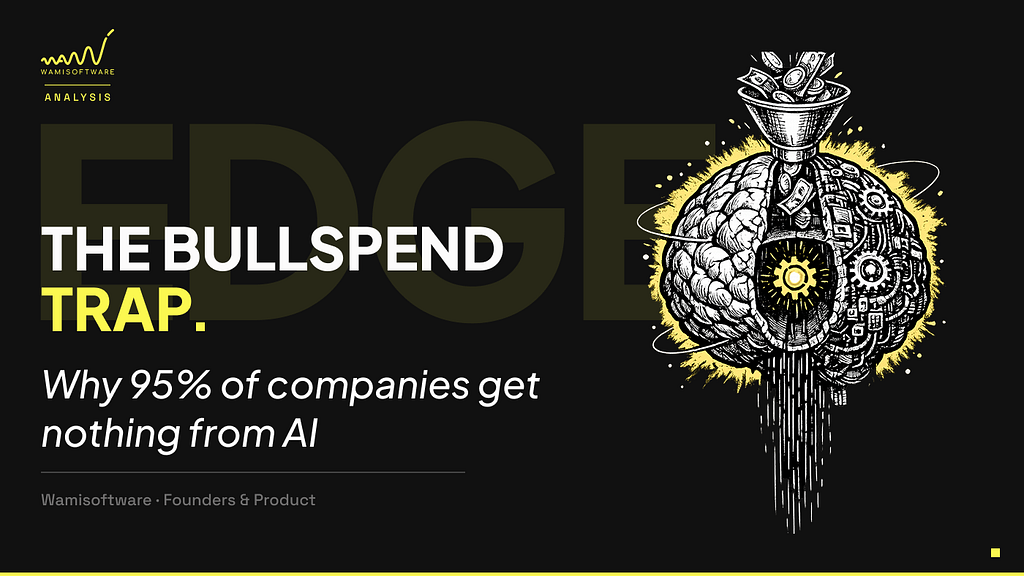
The Bullspend Trap: Why 95% of Companies Get Nothing From AI
The data is in. Most AI investment isn’t working. Here’s what the research says and what the 5% who succeed actually do. Companies are spending more on AI than ever. Plans call for 1.7% of revenue on AI in 2026 — double last year — with 94% continuing to invest even without immediate returns. And yet: MIT studied 300 AI initiatives and interviewed 150 executives. 95% of organizations achieved zero measurable retur…
The data is in. Most AI investment isn’t working. Here’s what the research says and what the 5% who succeed actually do.
Companies are spending more on AI than ever. Plans call for 1.7% of revenue on AI in 2026 — double last year — with 94% continuing to invest even without immediate returns.
And yet: MIT studied 300 AI initiatives and interviewed 150 executives. 95% of organizations achieved zero measurable return on their investments, despite $30–40 billion spent. PwC’s survey of 4,454 CEOs found 56% can show neither revenue growth nor cost reduction from their AI initiatives.
This is the bullspend trap. Spending more on something that isn’t working, hoping scale will fix the absence of strategy.
Why It Keeps Happening
IBM’s Marina Danilevsky described it perfectly: “People said, ‘Step one: we’re going to use LLMs. Step two: What should we use them for?’”
The tool gets bought before the task gets defined. The pilot runs for three months, delivers unclear results, and quietly dies. Nobody writes a post-mortem. The subscription renews.
More than 50% of GenAI budgets flow to sales and marketing — despite back-office automation delivering faster payback, with successful implementations generating $2–10M annually in cost reductions. Companies are optimizing for visibility, not for ROI.
What the 5% Do Differently
MIT researcher Aditya Challapally found that companies achieving real results do one thing: they pick one pain point, execute well, and partner smartly. Startups following this blueprint saw revenue jump from zero to $20 million in a year.
One pain point. One specific problem with clear measurement and someone accountable for the outcome.
External partnerships achieve 66% deployment success versus 33% for internally built tools — yet most organizations keep pursuing expensive internal development.
Define the problem. Build the measurement. Then deploy.
In practice this means being specific before being ambitious. Not “we want to use AI to improve customer experience” but “we want to reduce the time from contract receipt to first response from 48 hours to 4 hours, measured weekly.” One process. One metric. One owner.
The Readiness Problem Nobody Mentions
There’s a prerequisite most companies skip: being ready for AI.
“There is a readiness component to leveraging AI effectively. You have to have strategic data management, modernized computing, and cloud-native solutions to take advantage of AI,” says New York Life CIO Matt Marze, one of the executives consistently delivering positive AI returns.
AI doesn’t fix bad data. It amplifies it faster and at scale. Before asking “what AI should we deploy,” the more useful question is often “is our infrastructure capable of supporting what we’re trying to do?”
What This Means in Practice
The organizations that master AI return measurement now will know which initiatives to scale, which to sunset, and where to invest next. Those without this capability stay stuck in an endless cycle of pilots that never prove themselves worth scaling.
Effective AI consulting starts with a process audit where is the real friction, where is time being lost, where is human judgment applied to tasks that don’t require it. Then prioritization. Then implementation with accountability for results, not just delivery.
Almost every company can benefit from AI. The question is whether you’re approaching it in a way that shows up in your results or in a way that adds another line to the AI spend spreadsheet with nothing to point to.
Most companies are in the second category. They don’t have to stay there.
Wamisoftware works with startups and enterprise clients on AI integration and implementation. We start with the operational problem, define the measurement, and take accountability for the outcome.