May 14, 2026
The Agentic Leap: Why AI Agents Are the New Developers
We’ve been watching this shift from the inside. Here’s what it actually looks like when a non-technical founder runs a product with AI agents and what it means for how software gets built. One of our clients is a non-technical founder building a startup. He’s running his entire development process with AI agents and it’s working. The agents handle code generation, testing scaffolding, documentation, and routine ex…
We’ve been watching this shift from the inside. Here’s what it actually looks like when a non-technical founder runs a product with AI agents and what it means for how software gets built.
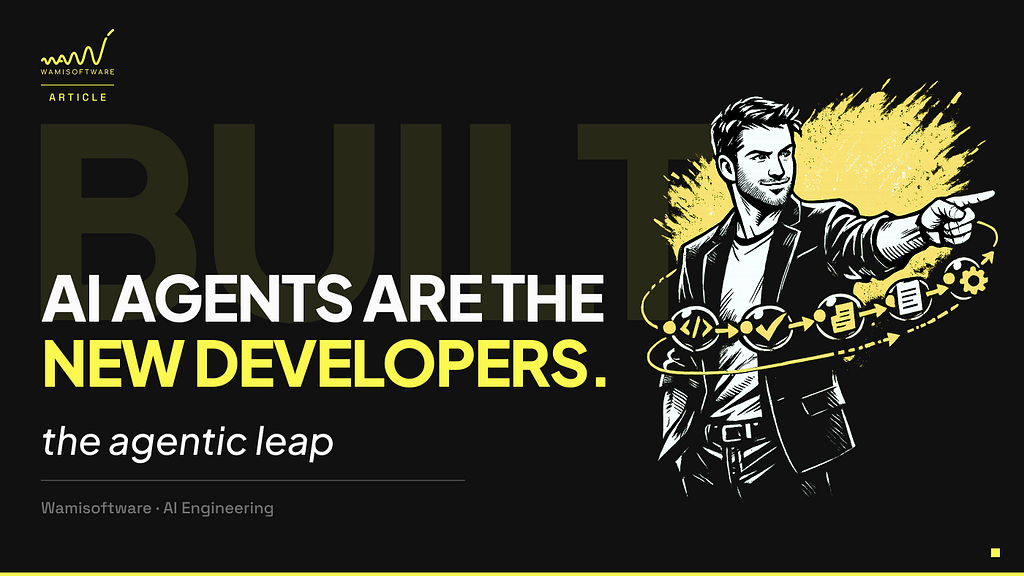
One of our clients is a non-technical founder building a startup. He’s running his entire development process with AI agents and it’s working.
The agents handle code generation, testing scaffolding, documentation, and routine execution. He handles product direction: what gets built, in what order, and why. Day to day, his job looks less like managing a development team and more like managing a production line — setting goals, reviewing outputs, adjusting direction.
When he came to us, the setup was already in motion. What he needed was someone to own the layer the agents couldn’t: architecture. Security. The decisions that determine whether what’s being built today will hold up six months from now.
So we placed one Senior developer alongside him. Not to take over the process — to be the person accountable for what’s under the hood.
That combination is the most honest picture we have of where development is going. A founder directing agents. A Senior controlling what they build toward. Both necessary. Neither replaceable by the other.
What “Agentic” Actually Means in Practice
The word gets used loosely, so it’s worth being specific.
An AI agent isn’t just a model that answers questions. It’s a system that takes a goal, breaks it down into steps, executes those steps across tools and environments, and adapts based on what it finds.
In development, this means an agent can take a feature specification, generate code across multiple files, run tests, interpret the results, fix what broke, and iterate — without a human intervening at each step.
The human’s role becomes: define the goal clearly, review the output at checkpoints, and make the calls that require understanding the product beyond the immediate task.
This is a fundamentally different relationship with the development process. And it’s not hypothetical anymore. We’re watching it happen in projects we’re part of.
Why This Doesn’t Make the Senior Developer Obsolete
Here’s the part that gets misunderstood.
The agentic model doesn’t reduce the need for expertise. It changes where that expertise is applied.
An agent executes within the boundaries it’s given. It doesn’t know that the architecture it’s building won’t scale past 10,000 users. It doesn’t know that the data model it’s generating will create compliance problems in six months. It doesn’t know when a technically correct solution is the wrong solution for this specific product at this specific moment.
That knowledge lives with experienced people. And in an agentic workflow, that knowledge becomes more important, not less because the agent will execute confidently on whatever direction it’s given.
A Senior developer in this model isn’t reviewing every line of code. They’re making the decisions that determine whether the agents are pointed at the right thing. That’s a higher-leverage role. It requires more judgment, not less.
The workflow in 2026 is increasingly “agent-first,” where the human acts as a “reviewer” rather than a “writer.” But reviewing well — knowing what to look for, what questions to ask, when to override — is itself a skill that takes years to develop.
The New Failure Mode
In classic development, things go wrong when developers make mistakes. In agentic development, things go wrong differently.
Agents are consistent and fast. If they’re pointed at the wrong goal, or given a specification with a subtle flaw, or operating within an architectural assumption that doesn’t hold — they’ll execute that mistake at scale and at speed. By the time it’s visible, it’s baked into a lot of code.
This is why the human layer matters more in agentic systems, not less. The cost of a bad decision early is higher because the agent has already acted on it extensively before anyone noticed.
We’ve started thinking about this as the “direction problem.” The agent’s execution is rarely the issue. The issue is whether it’s executing in the right direction. And that requires a human who deeply understands both the technology and the product it’s being built for.
What This Means for How Teams Are Structured
The implications for team structure are real and they’re already showing up.
New roles like “Agent Ops Lead” and “AI Product Owner” are emerging in companies that are planning for a world where AI agents manage the bulk of technical execution.
For smaller companies and startups, the shift is more immediate. A single Senior developer with a well-configured agent stack can now do work that previously required multiple people. Not because the Senior became superhuman but because the agents handle the execution volume, freeing the human to focus on decisions.
This changes the economics of building a product. It also changes what you need from the people you bring in. You need fewer people who can write code fast. You need more people who can think clearly about what the code should be doing and why.
The PM role is changing too. Specifications matter more now. An unclear requirement handed to a developer might result in a question. An unclear requirement handed to an agent swarm results in a lot of confidently generated code that solves the wrong problem.
We’ve seen this directly. The founder we mentioned understood this intuitively. He needed someone who could think about the product architecture clearly because that clarity was what the agents would execute from.
Where We Think This Is Going
The agentic model is early. The tooling is improving fast, the patterns are still being figured out, and most teams are somewhere in the middle — using agents for some things, humans for others, still learning where the boundaries are.
What we’re confident about is the direction.
The teams that figure out how to work well with agents — how to give them clear direction, review output effectively, and apply human judgment at the right moments — will move at a pace others can’t match.
The bottleneck in that equation was never the agents. It’s the humans who can direct them well.
Wamisoftware has been building software products since 2014. We work with startups and enterprise clients on AI integration, agentic development workflows, and technical architecture. If you’re thinking about how to structure a team around AI agents, we’re happy to start with the real questions.