May 7, 2026
Why the Best AI Projects Still Need a Human in the Loop
There’s a version of the AI future where humans are mostly optional. Models reason, agents execute, systems self-correct. The human sits at the edge of the process, occasionally approving things, mostly redundant. We’re not there. And the projects where people pretend we are tend to end badly. What We’ve Actually Seen We work on AI projects across different industries. Energy systems, healthcare applications, star…
There’s a version of the AI future where humans are mostly optional.
Models reason, agents execute, systems self-correct. The human sits at the edge of the process, occasionally approving things, mostly redundant.
We’re not there. And the projects where people pretend we are tend to end badly.
What We’ve Actually Seen
We work on AI projects across different industries. Energy systems, healthcare applications, startup products, enterprise integrations. The range matters because the failure modes are different everywhere — but one pattern shows up consistently.
The projects that work aren’t the ones with the most sophisticated models. They’re the ones where someone with deep expertise is genuinely involved in shaping what the AI does and reviewing what it produces.
Not as a bottleneck. As a structural part of the system.
The Prompt Is Already a Human Decision
Every AI system starts with a choice a human made.
What data goes in. What the model is optimized for. What counts as a good output. What gets filtered out. These decisions happen before the AI does anything — and they encode assumptions, priorities, and blind spots that the model will faithfully reproduce at scale.
A model trained on biased data doesn’t know it’s biased. A system optimized for engagement doesn’t know that engagement and wellbeing sometimes point in opposite directions. A recommendation engine doesn’t know that some recommendations, delivered to the wrong person at the wrong moment, cause harm.
The human in the loop isn’t there to catch the AI making mistakes. They’re there because the decisions about what the AI is trying to do require judgment that AI doesn’t have.
The Gap Between “Works” and “Works Well”
In software development, this gap is visible in a specific way.
Vibe coding using AI to generate large amounts of code quickly — is real and genuinely useful. A solo founder can ship an MVP in days. A small team can move at a pace that wasn’t possible two years ago.
But “works” and “works well at scale, under load, with real users and real data” are different things.
We had a client building an AI-native product entirely through Vibe Coding. Smart, technically fluent, moving fast. He knew what he wanted. The AI generated, he directed.
But he still brought in a Senior developer. Not to take over — to control architecture, ensure the system would hold up under growth, and review what the AI produced at decision points that mattered.
When we asked why, the answer was straightforward: he’d seen what happens when you skip that step.
The AI produces code that works until something changes. Then the cost of that speed becomes visible.
Where the Stakes Are Higher
In regulated industries, the gap between “works” and “works safely” has a different weight.
We built an emotional health app — a platform that tracks users’ emotions and habits and provides AI-powered recommendations to support wellbeing. The technical challenge was real: scalable architecture, real-time analysis, performance under load.
But the harder problem wasn’t technical.
AI that works with emotional data needs to recommend carefully. A suggestion that helps one person could harm another. Confidence in an output that should be tentative is a failure mode. Silence when a user needs to be directed toward human support is a failure mode.
The human judgment involved in designing those boundaries — what the AI says, how it says it, when it defers — can’t be replaced by more training data or a better model. It requires someone who understands both the technology and the human context it operates in.
No regulator will accept “the model decided” as an answer for why a health application gave a user harmful guidance. Nor should they.
What Actually Changed When We Started Using AI
We use AI extensively. Our developers use Claude, Codex, Cursor, Copilot. We’ve moved to working with agents. We’ve changed how we structure work, how we approach tasks, how fast we can move on certain problems.
The question isn’t whether to use AI. It’s about understanding what AI is good at and what it isn’t and building systems that reflect that honestly.
AI is very good at pattern recognition, at generating outputs across a defined space, at processing volume that humans can’t handle, at operating without fatigue. These are real advantages.
AI is not good at knowing when the rules it learned don’t apply. At recognizing context that wasn’t in the training data. At understanding that a technically correct output is the wrong output for this specific situation. At accountability.
A Senior developer reviewing AI-generated code isn’t slowing down the process. They’re the part of the system that catches what the AI can’t see about itself.
The Shape of the Human Role Is Changing
None of this means the human role stays the same.
The PM who used to manage sprints is now the person who translates business logic into specifications that AI can execute correctly. The developer who used to write every line is now the person who controls what the AI generates and ensures the architecture holds. The analyst who used to write reports is now the person who asks the right questions of AI-generated outputs.
The skills that matter are shifting. But the judgment, the context, the accountability — those stay human.
In the projects we’ve seen fail, the mistake wasn’t using AI. It was assuming that AI could handle the parts of the work that require those things.
A Useful Test
Before deploying any AI system, there’s one question worth asking seriously.
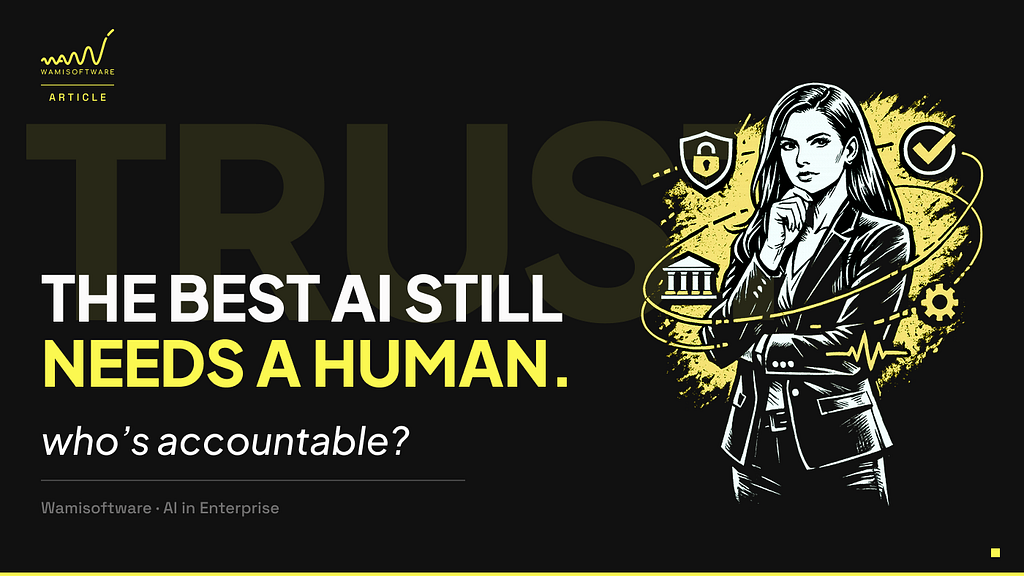
When something goes wrong and something always eventually goes wrong — who is accountable? Can you point to a human who made the decisions that led to that outcome, who understood what the system was doing and why, who can explain it and fix it?
If the answer is unclear, the human isn’t in the loop. They’re just watching.
The best AI projects have a clear answer to that question. Not because they don’t trust the technology. Because they understand what trust actually requires.
Wamisoftware builds AI solutions for startups and enterprise clients. We work on the hard problems: architecture that scales, systems that handle sensitive data safely, and the integration of AI into environments where getting it wrong has real consequences.
<a href=”https://storyset.com/technology">Technology illustrations by Storyset</a>