Apr 30, 2026
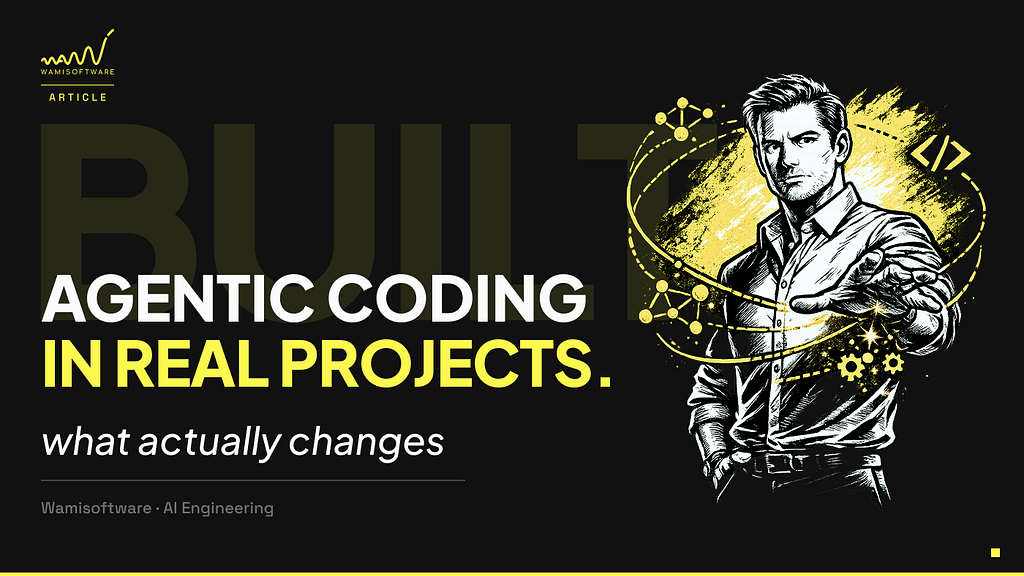
Agentic Coding in Real Projects: What Actually Changes When AI Enters the Development Process
At Wamisoftware, we don’t talk about AI trends in the abstract. We work with them daily — across projects, teams, and client conversations. When Anthropic published its 2026 Agentic Coding Trends Report, identifying eight shifts reshaping how software gets built, most of it felt familiar. Not because we read ahead, but because we’ve been living inside these changes for the past year. This article is our honest acc…
At Wamisoftware, we don’t talk about AI trends in the abstract. We work with them daily — across projects, teams, and client conversations. When Anthropic published its 2026 Agentic Coding Trends Report, identifying eight shifts reshaping how software gets built, most of it felt familiar. Not because we read ahead, but because we’ve been living inside these changes for the past year.
This article is our honest account of what agentic coding looks like in practice — what shifts, what doesn’t, and what it means for the people building products today.
The shift that matters most isn’t speed
Everyone talks about velocity. And yes, projects move faster when AI is embedded in the development workflow. But in our experience, speed is a byproduct — not the point.
The real shift is cognitive.
When agentic AI becomes part of how an engineer works, the questions they ask change. The focus moves from “how do I implement this?” to “why are we implementing it this way, and what does it actually give the product?” That sounds subtle. In practice, it changes the quality of every decision made throughout a project.
Engineers who previously optimized for task completion start thinking about process and business outcome. Not because they’re asked to — because the tools create space for it. When repetitive implementation work is handled by AI, human attention naturally moves upstream.
What the engineer’s role actually looks like now
The Senior developer of 2024 was defined by their ability to execute complex tasks with precision. The Senior engineer of 2026 is something different: an architect of solutions who uses AI as a multiplier of their own expertise.
This distinction matters more than it might seem.
A multiplier amplifies what’s already there. If the underlying expertise is strong — deep architectural thinking, sound judgment about trade-offs, experience with failure modes — agentic tools make that expertise faster and broader in its reach. One experienced engineer can now hold a level of oversight and output that previously required a larger team.
But the inverse is also true. If the expertise isn’t there, AI doesn’t compensate for it. It accelerates whatever is driving the process — including mistakes.
This is why, at Wami, our model has always been Senior-only. Agentic coding hasn’t changed that principle. If anything, it’s made the reasoning behind it more visible.
Multi-agent coordination: the promise and the constraint
One of the more significant practical changes we’ve seen is in how parallel workstreams are managed. Tasks that previously required extended alignment across teams — synchronizing requirements, resolving dependencies, maintaining consistency across components — can now be handled within more contained working sessions.
Multi-agent systems, where several AI agents work in parallel on different parts of a problem and then synthesize results, are moving from experimental to operational. We’re seeing this in production environments, not just prototypes.
The constraint, however, is real: someone still needs to hold the architectural integrity of the whole. Agents can optimize locally. They can execute within defined parameters. What they can’t do is carry the judgment required to make decisions when those parameters conflict when a technically correct solution creates a business problem, or when the right architecture for today creates the wrong constraints for six months from now.
That judgment is still human. And it’s becoming more valuable, not less, as the automated layer around it grows more capable.
What this means for clients
When we describe this shift to clients, the conversation usually starts with speed and cost. Those are real. But the more important outcome is different.
A team operating with agentic tools and with the expertise to use them well — doesn’t just deliver faster. It thinks differently about the product. The cognitive overhead that used to go into implementation logistics gets redirected toward understanding the business problem more deeply.
In practice, this means fewer surprises late in a project. It means technical decisions that are better connected to business intent. And it means a team that’s genuinely invested in the outcome, not just the output.
The part that doesn’t change
Agentic coding is not a replacement for engineering culture. The values that make a development team genuinely useful to a business — care about the product, transparency in communication, willingness to raise difficult technical truths — those aren’t features of a tool. They’re features of people and the environment they work in.
At Wamisoftware, we’ve spent ten years building a culture where developers think about product success the way an owner does. Agentic AI fits into that culture. It doesn’t substitute for it.
The teams that will get the most from these tools are the ones that already have strong foundations: clear ownership, good judgment at the senior level, and a genuine orientation toward the client’s business goals.
For everyone else, agentic coding will produce faster output. Whether that output creates value is a different question.
Wamisoftware is a software development company building products since 2014. We work as a seamless extension of our clients’ teams — Senior engineers only, with a focus on business outcomes over task completion.
<a href=”https://storyset.com/technology">Technology illustrations by Storyset</a>